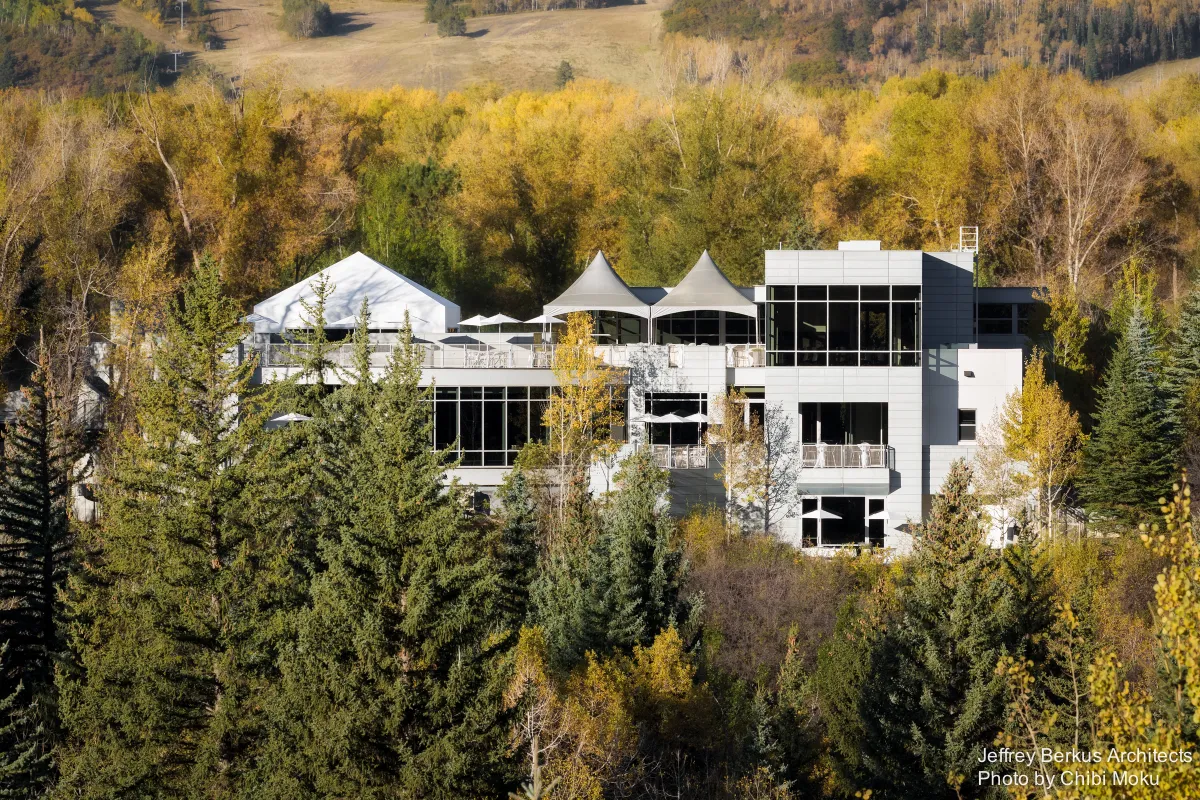
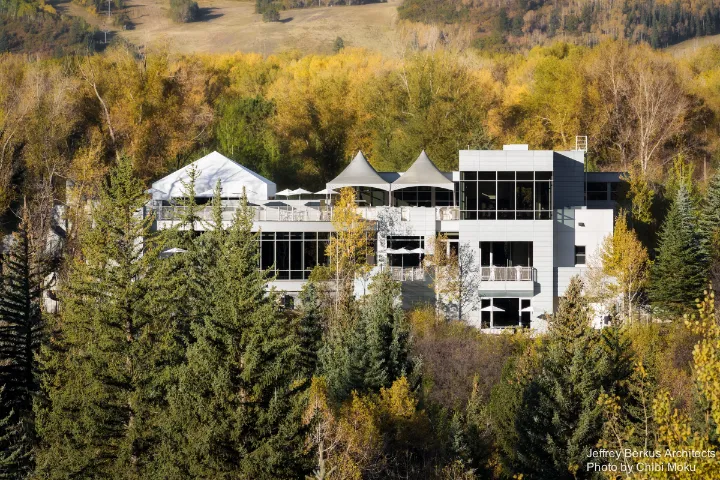
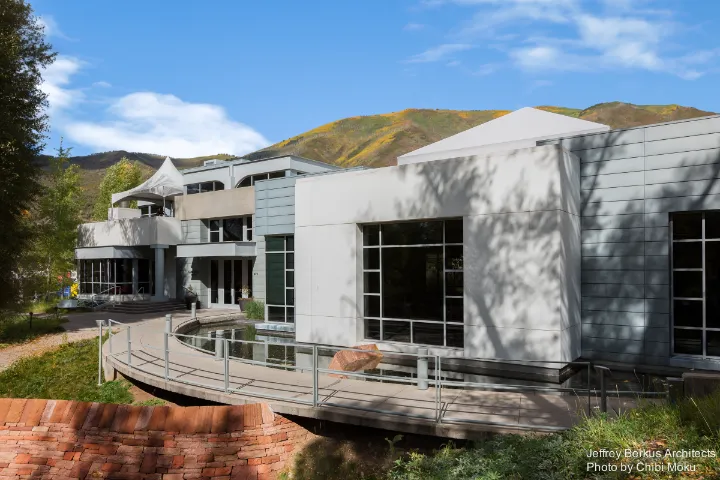
The Aspen Institute’s Doerr Hosier Center, designed by Jeffrey Berkus Architects with interiors by River Terrace Design and built by Shaw Construction, was created for a very specific kind of work: bringing people together to wrestle with the most divisive and consequential issues of our time. In the film, Walter Isaacson describes how the Aspen Institute tries to shape dialogue not by forcing agreement, but by helping people return to shared human values. As he explains, “We’re trying to bring the notion that we have a basic set of values that most of us share… and that if you understand those values and build on them you can get to a lot of common ground on the contentious issues of our time.” That theme is embedded into the architectural intention of the building, which is less about spectacle and more about shaping a setting where people can think clearly, slow down, and engage one another at a higher level.
Isaacson makes a direct connection between the building’s setting and its psychological effect. “Nature has a magical way of diffusing this tension,” he says, describing how the surrounding mountain landscape helps people release ego and become more receptive. In his words, the conflicts of modern life “seem to pale when you’re looking at the beauty of the mountains… you have part of something timeless and somehow that can make you more elevated in your thinking.” This is not just poetic narration, it is the design premise. Jeffrey Berkus Architects responded by creating a conference center that rejects the typical sealed, dim “ballroom-and-breakout-room” model and instead treats the outdoors as an architectural partner. Meeting and gathering spaces open outward to terraces and views, making it difficult to forget the site, the weather, the sky, and the natural rhythm of Aspen itself.
A defining move is the integration of an Andy Goldsworthy stone wall into the building’s lived experience. Isaacson points to its symbolic role and its physical seriousness: “Andy Goldsworthy’s stone wall has pieces of stone from conflict areas around the world, but they fit together.” The wall does not sit outside as a detached sculpture. He notes what makes it “magical” is how “that wall is not just outside the building as an ornament, it curves into the building… and all the way through the floor of the main hall.” That is architecture doing what Aspen does culturally, turning division into continuity, and using material, craft, and placement to suggest that “common ground” can be constructed rather than merely hoped for. The building’s exterior palette of pre-cast concrete, zinc, steel, and glass continues that idea: durable, low-maintenance, and modern, but respectful of the campus’ established language.
The spatial sequence reinforces focus and emotional regulation, especially on arrival. Isaacson describes the internal intensity of what happens on campus: “There’s some pretty intense conversations and topics that are dealt with within this building.” Because of that, the building is designed to lower the temperature of the mind before discussion even starts. The approach path curves, passing water and stone elements that are intended to slow you down and shift perception. Inside, the lobby is intentionally precise and calming in its geometry, and the daylighting strategy uses north-facing glass so the interior light feels soft, not harsh or fatiguing. The goal is that your eyes rest and focus beyond, rather than being trapped in glare and artificial light.
Ultimately the Doerr Hosier Center works because it is not just a facility, it is a framework for human interaction. Isaacson describes the Aspen Institute as “the annual forum for an exchange of ideas around the environment, around health, around diplomacy,” bringing together “world leaders” and critical thinkers in a setting that makes difficult dialogue possible. That is why the architecture matters. It is designed not to dominate the campus, but to support the people inside it, offering daylight, openness, and connection to landscape as tools. In that sense, the building becomes an embodiment of Isaacson’s core message: build on what we value, reduce tension, and make room for real conversation.