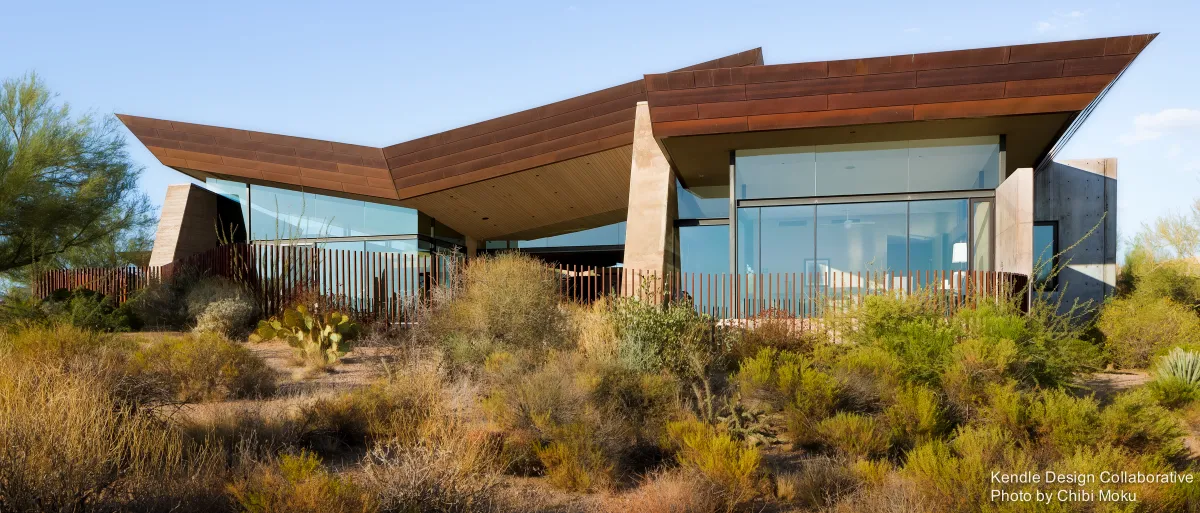
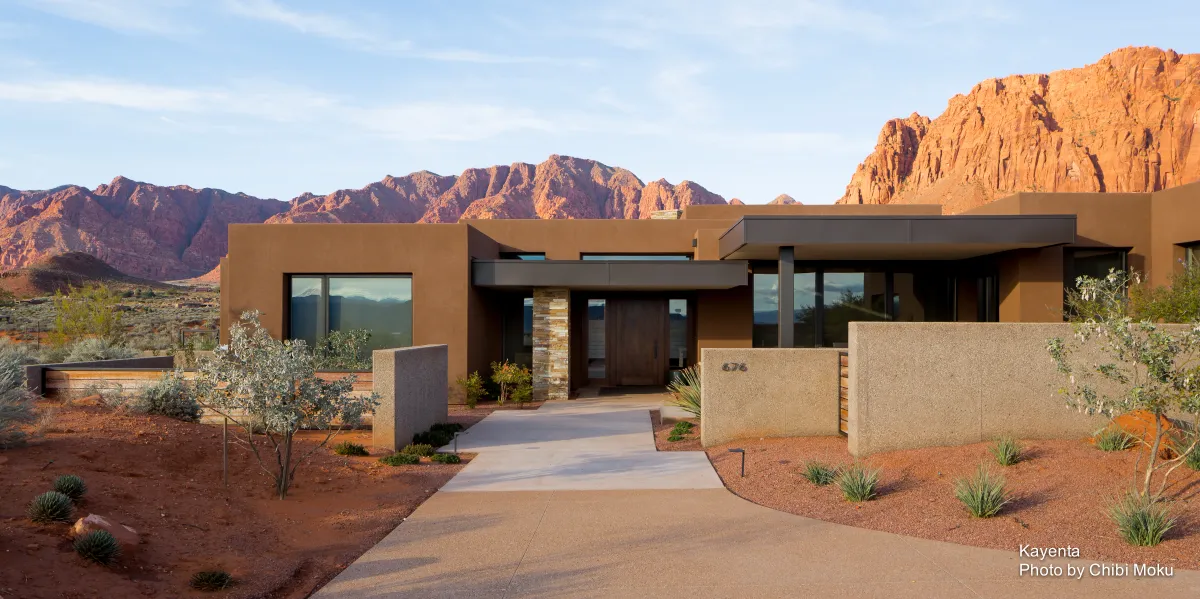
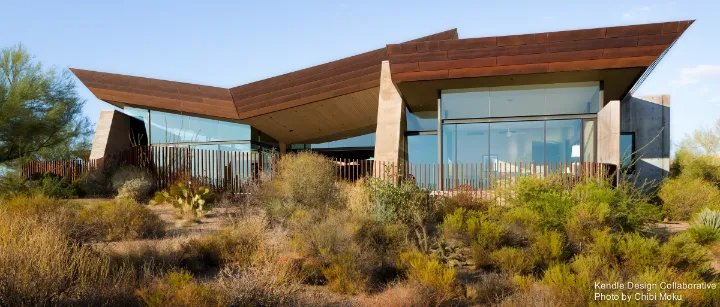
Desert Wing is one of those projects where Kendle Design Collaborative makes modern architecture feel completely at home in the Sonoran landscape. Designed by Brent Kendle, AIA, LEED AP in Scottsdale, Arizona, the house is shaped around the idea that the desert is not something to “block out,” but something to celebrate. Kendle describes it as “organic modern,” and it’s easy to see why: the rooflines rise and tilt like the surrounding mountains, giving the home a profile that feels like it’s responding directly to the terrain rather than sitting on top of it.
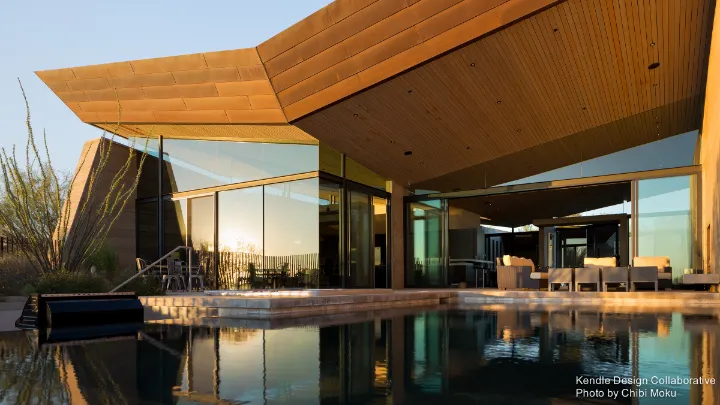
One of the defining moves is the dramatic roof system, which Kendle says “rarely actually touches anything,” floating above the walls with a continuous band of glass wrapped around the perimeter. The butterfly roof isn’t just a visual gesture either, it collects rainwater, a meaningful design decision in a climate where water is precious. Kendle explains that the interior sequence is intentionally choreographed: you enter under a lower ceiling and then the space “crescendoed…towards the view,” using structure to shape emotion and orientation without needing excess ornament.
Material transitions are treated almost like a timeline of the desert itself. The home’s signature element is its rammed earth walls, constructed using site soil mixed with Portland cement and compacted in layers. Kendle emphasizes how time-consuming and physical the process is, but also why it matters: rammed earth carries “a spirit of the land,” with a cultural and historical resonance tied to indigenous building traditions in the region. From that heavier, ancient texture, the home progressively refines itself into concrete walls, terrazzo-like concrete floors, and finally into the more tactile details like sinks and fixtures, what Kendle calls a progression “from start to finish” through essentially one family of material logic.
Even the cooling strategy is architectural rather than mechanical-first. Water appears throughout the home, not only as a visual feature but as performance infrastructure. Kendle notes they placed water “strategically” so that breezes passing across it cool down before being drawn through the house, using passive cooling principles to make the home more livable while staying aligned with the desert climate. That same thinking continues in the private spaces, where the master suite echoes the main pavilion roof in a smaller, lower, more intimate form, surrounded by glass that frames desert views at waking and at night.
The plan also resolves hospitality in a very desert-specific way: guests can stay in a separate wing with their own entrance and courtyard, giving privacy without disconnecting them from the main home. Pete and Laurelai wanted visitors to feel part of the larger household, but also able to retreat into “their own little world.” In Kendle’s words, the real goal goes beyond style, it’s philosophy: when architecture is built around nature, people become “healthier” and “happier,” and the materials themselves should “celebrate and embrace each other.” Desert Wing shows what that looks like when it’s executed with discipline and clarity.